
What is Erectile Dysfunction? Causes, Symptoms & When to See a Doctor

Updated: Jun 6


Written: By Dr. Arpit Agrawal ( BHMS, Nutrition & Psychology )
There is a conversation most men never have — not with their doctor, not with their partner, and often not even with themselves.
It starts quietly. Maybe the first time you brush it aside as tiredness or stress. The second time, you start to worry but say nothing. By the third or fourth time, the silence becomes a wall — heavy, isolating, and deeply harmful to your confidence, your relationships, and your health.
I am talking about Erectile Dysfunction. And in my years of homeopathic practice, I can tell you this: it is far more common than you think, far more treatable than you fear, and far more important to address than most men realise.
This blog is my attempt to break that wall of silence — with facts, clarity, and the deep understanding this topic deserves.
What Exactly Is Erectile Dysfunction?
Erectile dysfunction (ED) — also called impotence — is the consistent or recurrent inability to achieve or maintain a penile erection firm enough for satisfactory sexual intercourse. The key word here is consistent. An occasional difficulty getting or keeping an erection is entirely normal for any man and is not a cause for alarm. Life happens — stress, fatigue, alcohol, a bad day — and the body reflects that.
ED becomes a medical concern when this difficulty occurs regularly, is predictable, causes distress, and begins to affect your quality of life or intimate relationships.
Clinically, the International Index of Erectile Function (IIEF) — the most widely used global assessment tool — grades ED by severity:
Mild ED — Erections occur, but firmness or duration is inconsistent
Mild-to-moderate ED — Notably reduced erectile ability, affecting intercourse frequency
Moderate ED — Significant difficulty; intercourse possible only sometimes
Severe ED — Near-complete or complete inability to achieve or maintain an erection
Understanding where you fall on this spectrum is the first step to choosing the right treatment. And from a homeopathic perspective, even severe ED has roots that can be identified and treated.
How Common Is ED in India? The Numbers That Should Make You Take Notice
Many Indian men suffer in silence, believing they are alone in this struggle. They are not — not even close.
Studies indicate that the prevalence of ED in India ranges from 12% to 50% among men across different age groups — a staggering number in a country of over 700 million adult men. That means at minimum, tens of millions of Indian men are living with some form of this condition right now.
Globally, the picture is equally stark. The prestigious Massachusetts Male Aging Study found a total prevalence of erectile dysfunction of 52% in men aged 40–70. By 2025, the number of men affected worldwide was projected to reach approximately 322 million — representing an increase of over 111% since 1995.
In India specifically, the burden is compounded by rapidly changing lifestyles, the world's largest diabetic population, rising stress levels, and a deep cultural reluctance to discuss sexual health.
Research published in the Indian context suggests that in urban India, workplace pressures — long working hours, targets, night duties, and dual-income household stress — are emerging as significant contributors to sexual dysfunction.
The message is clear: this is not a rare or shameful condition. It is a public health issue that deserves the same open conversation as diabetes or hypertension.
The Physiology of an Erection: Why It's More Complex Than You Think

To understand why ED occurs, you first need to understand how an erection actually works — because it is genuinely one of the most complex coordinated events in the human body.
An erection requires a precise, simultaneous coming-together of four systems:
1. The Nervous System — Sexual stimulation (visual, tactile, or psychological) sends signals through the brain, down the spinal cord, to the nerves supplying the penis. Any disruption here — stress, anxiety, spinal injury, diabetic neuropathy — breaks this chain.
2. The Vascular System — The brain's signal causes the smooth muscle of the penile arteries to relax, flooding the spongy erectile tissue (corpus cavernosum) with blood. Simultaneously, venous drainage is restricted, trapping blood and creating rigidity. Atherosclerosis, high blood pressure, or high cholesterol can impair this blood flow.
3. The Hormonal System — Testosterone, produced by the testes, is the primary driver of sexual desire. Low testosterone, thyroid dysfunction, or elevated prolactin directly suppresses this system.
4. The Psychological System — The brain is, ultimately, the master sexual organ. Performance anxiety, depression, relationship conflict, and past trauma can override every physical signal and prevent an erection regardless of how healthy the other systems are.
This is exactly why homeopathy is so well-suited to treating ED — it is one of the very few systems of medicine that treats the person as a whole, addressing physical, hormonal, and psychological dimensions simultaneously rather than just prescribing a pill for blood flow.
What Causes Erectile Dysfunction? A Comprehensive Look
ED rarely has a single cause. In most men — especially Indian men in the 30–60 age group — it is multifactorial, with physical and psychological causes interwoven. Let me walk you through each major category.
Physical (Organic) Causes
Cardiovascular Disease & High Blood Pressure
This is the most important physical cause, and one that many men are completely unaware of. The arteries supplying the penis are narrower than coronary arteries — which means atherosclerotic damage shows up in the penis before it shows up as a heart attack.
Research published in the American Heart Association journal Circulation found that men with ED were more than twice as likely to experience heart attacks, cardiac arrests, or strokes compared to men without ED.
Mayo Clinic now formally recommends that erectile dysfunction be treated as a vital sign for cardiovascular health — particularly in younger men — as a risk-enhancing marker for silent coronary artery disease.
In clinical practice, this means that when I see a middle-aged man with ED, cardiovascular health is always part of my assessment — because the penis, quite literally, may be telling us something the heart hasn't said yet.
Diabetes Mellitus
India is the diabetic capital of the world — and the connection between diabetes and ED is profound. Diabetic patients are 3–4 times more likely to develop erectile dysfunction compared to non-diabetic men. High blood sugar damages both the nerves (diabetic neuropathy) and the blood vessels (microvascular disease) that are essential for erectile function.
A multicenter observational study across 11 centres in Lucknow, North India found ED prevalence of 32% among men with Type 2 diabetes — and this is likely an underestimate, since under-reporting is rampant.
Hormonal Disorders
Low testosterone (hypogonadism), thyroid dysfunction (both hypothyroidism and hyperthyroidism), and elevated prolactin levels are significant and frequently underdiagnosed hormonal causes of ED in Indian men. Obesity, which raises oestrogen and suppresses testosterone, compounds this.
Neurological Conditions
Spinal cord injuries, multiple sclerosis, Parkinson's disease, and peripheral neuropathy (often diabetic) can disrupt the nerve signals essential for erection.
Medications
This surprises many patients: certain commonly prescribed medications can cause or worsen ED. These include some antihypertensives (particularly beta-blockers and thiazide diuretics), antidepressants (SSRIs), antipsychotics, anti-androgens, and certain antihistamines. If your ED started after beginning a new medication, always tell your doctor.
Tobacco, Alcohol & Substance Use
Chronic smoking damages vascular endothelium directly — the same endothelium that enables blood flow into the penis. Research has shown that smoking is significantly associated with ED. Similarly, chronic alcohol use suppresses testosterone production and damages nerve function over time.
Psychological (Psychogenic) Causes

Psychological causes of ED are not "imaginary" or "weak" — they represent a real, physiological disruption of the brain-body signal pathway. They are extremely common in young Indian men, and often more distressing because the man feels physically healthy yet cannot perform.
Performance Anxiety
This is the most common psychological cause in men under 40. After one episode of erection failure — however innocent the cause — the mind creates a "fear of failure" loop. At the next sexual encounter, this anxiety triggers the sympathetic nervous system (fight-or-flight), which actively suppresses erection. The feared failure then occurs, reinforcing the anxiety. This cycle can trap a man for years.
Depression
Depression is deeply linked to ED — through both neurochemical pathways (low dopamine and serotonin affect sexual arousal) and through reduced libido, fatigue, and withdrawal from intimacy. Critically, many antidepressants prescribed for depression also worsen ED, creating a difficult therapeutic challenge.
Relationship Conflict & Emotional Disconnection
Unresolved conflict, trust issues, lack of communication, or emotional distance from a partner creates a psychological environment in which sexual response is suppressed. The body cannot be aroused where the mind feels unsafe or hostile.
Stress — Chronic & Acute
Elevated cortisol from chronic stress suppresses testosterone and impairs the blood flow mechanism. In urban India — with its IT deadlines, business pressures, financial anxieties, and commute stress — this is increasingly the primary driver of ED in the 30–45 age group.
Grief, Trauma & Loss
In homeopathy, we see this regularly: ED that begins after the death of a loved one, a business failure, or a traumatic event. The remedy Phosphoric Acid is, in fact, classically indicated for ED that develops following deep grief or mental exhaustion — a perfect example of why individualized constitutional treatment matters.
Mixed (Organic + Psychogenic) Causes
In the majority of middle-aged Indian men, ED is mixed — a physical vulnerability (poor blood flow, borderline hormones, early diabetes) combined with a psychological response (anxiety, self-doubt, avoidance). Each makes the other worse. This is why a treatment that only addresses blood flow — like a PDE5 inhibitor — often gives incomplete or short-lived results.
Symptoms of Erectile Dysfunction: Beyond the Obvious
Most men define ED only as "not getting an erection." But the clinical picture is broader, and recognising these nuances helps in both diagnosis and appropriate treatment.
Core symptoms:
Difficulty achieving an erection when desired
Erection that is not firm enough for penetration
Erection that is lost before or during intercourse
Inability to achieve an erection at all
Associated symptoms that often accompany ED:
Reduced sexual desire or libido (points to hormonal cause)
Premature ejaculation (often coexists with psychogenic ED)
Absence of morning erections (a clinically important sign — healthy men typically have 3–5 nocturnal or morning erections; their absence suggests an organic cause)
Genital coldness or reduced sensitivity (can indicate neuropathy)
Fatigue, depression, low mood (suggests systemic or hormonal cause)
The morning erection test — one of the most useful self-assessments — deserves special mention. If morning erections are present but ED only occurs with a partner, the cause is almost certainly psychological. If morning erections are absent or rare, there is likely an organic component. This distinction guides the entire treatment direction.
Is It ED or Something Else? Distinguishing ED from Related Conditions
Several conditions are commonly confused with erectile dysfunction, or frequently coexist with it:
Premature Ejaculation (PE) — The ability to achieve an erection is intact, but ejaculation happens before or shortly after penetration. PE and ED are distinct, though they often occur together due to shared psychological roots.
Loss of Libido / Low Sexual Desire — No desire or urge for sex, distinct from inability to maintain an erection when desired. Primarily hormonal (low testosterone, high prolactin) or psychological.
Peyronie's Disease — Fibrous scar tissue causes a curved, painful erection. Erections are possible but intercourse may be painful or impractical.
Ejaculatory Disorders — Retrograde ejaculation, anejaculation — disorders of the ejaculation process that may be confused with or accompany ED.
Understanding these distinctions is essential because each condition calls for a different therapeutic strategy.
Is ED Just a Sexual Problem? Why This Matters Far Beyond the Bedroom
I want to address something that is deeply underappreciated — especially in India, where men are conditioned to suffer in silence around sexual health.
Erectile dysfunction is a systemic health signal, not merely a bedroom problem.
Research has firmly established that men with ED have a significantly increased risk of all-cause mortality and cardiovascular mortality. Men with erectile dysfunction are 1.68 times more likely to develop dementia than men without it. ED shares pathological roots with cardiovascular disease, metabolic syndrome, diabetes, and neurological decline.
Untreated ED also has profound psychological consequences:
Chronic low self-esteem and masculine identity crisis
Depression and social withdrawal
Relationship breakdown and marital conflict
Increased risk of anxiety disorders
The man who avoids addressing ED is not "dealing with it" — he is allowing a systemic health signal to be ignored, often at great cost to his physical and mental wellbeing over time.
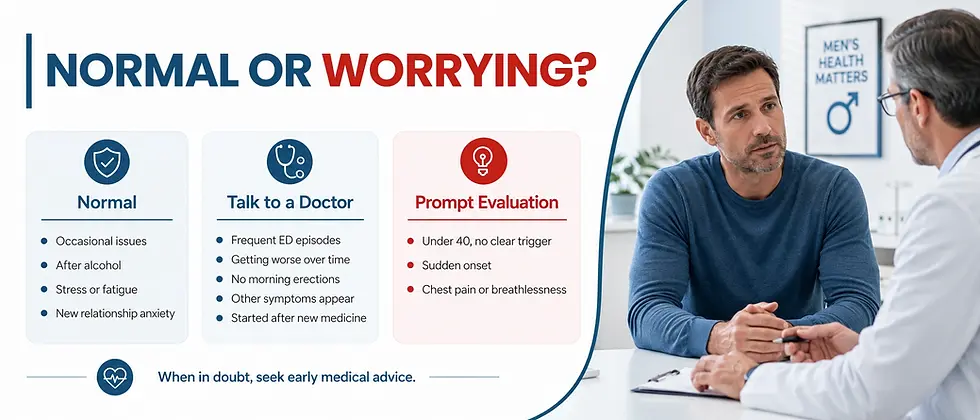
When Is It Normal vs. When Should You Worry?
This is the question I am asked most often in my practice, and it deserves a direct, honest answer.
Completely normal — no cause for concern:
Occasional failure to achieve or maintain an erection (once in a few weeks or months)
ED after excessive alcohol consumption
Erection difficulty during periods of extreme stress, illness, or severe fatigue
Performance anxiety during a new relationship
Should be discussed with a doctor:
ED occurring in more than 25–50% of sexual attempts over a period of several weeks
Progressive worsening of erection quality over months
Complete absence of morning erections
ED accompanied by other symptoms: fatigue, weight changes, reduced beard growth, urinary symptoms
ED that started after beginning a new medication
ED causing significant distress, anxiety, or relationship difficulty
Requires prompt evaluation:
ED in a man under 40 with no obvious trigger
ED appearing suddenly (not gradually) — can signal acute hormonal, vascular, or neurological cause
ED accompanied by chest pain, breathlessness, or cardiovascular symptoms (given the heart connection, this is urgent)
The threshold for consultation should always err toward earlier rather than later. In my practice, I have identified undiagnosed diabetes, hypertension, and early cardiovascular risk in patients who came to me primarily complaining of ED. The erection was the body's way of raising an alarm — and we were grateful it was heeded.
How Does a Doctor Evaluate ED? What to Expect
Many men delay consulting a doctor because they do not know what the evaluation involves and fear embarrassment. Let me demystify this entirely.
A proper initial evaluation of ED involves:
1. Detailed case history This is the most important part of any assessment — and in homeopathy, it is the foundation of treatment. Your doctor will ask about:
Duration and severity of ED
Presence or absence of morning erections
Any associated symptoms (urinary, libido, mood)
Medical history: diabetes, hypertension, heart disease, thyroid disorders
Medications being taken
Lifestyle factors: smoking, alcohol, sleep, stress levels
Psychological history: anxiety, depression, relationship health
Sexual history: any trauma, previous sexual function
2. Physical examination Examination of the genital area, assessment of secondary sexual characteristics (body hair, breast tissue), blood pressure measurement, and abdominal examination for signs of metabolic syndrome.
3. Basic blood investigations
Fasting blood glucose and HbA1c (diabetes screening)
Lipid profile (cardiovascular risk)
Complete blood count
Testosterone (total and free), LH, FSH
Thyroid function tests
Prolactin (if low libido is prominent)
4. Specialised investigations (if indicated)
Penile Doppler ultrasound (blood flow assessment)
Nocturnal penile tumescence (NPT) testing (to distinguish organic from psychogenic)
Psychological assessment tools
In my online consultations for patients across India, I conduct a thorough written case history that covers all these dimensions. For investigations, I guide patients on what to get done locally and then interpret the results as part of individualised treatment planning.
The Homeopathic Perspective: Why ED Is Never Just One Thing
As a homeopathic physician, I approach every case of ED with a principle that allopathic medicine often overlooks: the body is a unified system, not a collection of independent parts.
When a man comes to me with ED, I am not looking for a medicine that dilates penile blood vessels. I am looking for the man behind the symptom — his constitution, his temperament, his stress patterns, his fears, his physical tendencies, and his life story. Because ED in a 35-year-old with performance anxiety following a humiliating sexual experience is an entirely different medical reality from ED in a 55-year-old diabetic with nerve damage and poor circulation — even if the presenting complaint sounds identical.
This is the constitutional approach in homeopathy, and it is what makes the therapy so uniquely suited to a condition as multifactorial as erectile dysfunction.
Homeopathy does not suppress the symptom. It works by stimulating the body's own regulatory intelligence — the vital force — to restore normal function. It addresses nerve sensitivity, hormonal balance, vascular tone, and psychological resilience simultaneously. And critically, it does this without the side effects, dependency, or cardiovascular risks associated with pharmaceutical ED drugs.
I have treated hundreds of patients across India with ED through homeopathy — young men with psychogenic ED, middle-aged men with diabetic ED, and older men with mixed organic-psychological ED. In the vast majority of cases, with the right constitutional remedy and appropriate lifestyle support, significant and lasting improvement is achievable.
Final Word From My Practice
In fifteen years of homeopathic practice, the pattern I have seen most consistently is this: the men who suffer the most are not those with the most severe ED. They are the ones who waited the longest.
Erectile dysfunction, like any health condition, is far more responsive to treatment when addressed early. It is also — and this is critical — a signal that your body may be sending you about cardiovascular health, blood sugar, hormonal balance, or mental wellbeing that deserves attention far beyond the bedroom.
You are not less of a man for experiencing this. You are not alone in it. And you do not have to manage it with a pill that creates dependency, carries cardiovascular risks, and treats nothing but the symptom.
There is a better way. There has always been a better way.
Frequently Asked Questions
Can ED be cured permanently?
In many cases, yes — particularly when the underlying cause is addressed. Psychogenic ED, hormonal ED, and lifestyle-driven ED respond very well to homoeopathic constitutional treatment. The goal is not ongoing dependency on any medicine, but restoration of natural function.
In many cases, yes — particularly when the underlying cause is addressed. Psychogenic ED, hormonal ED, and lifestyle-driven ED respond very well to homoeopathic constitutional treatment. The goal is not ongoing dependency on any medicine, but restoration of natural function.
Is ED a normal part of ageing?
It is common with ageing, but it is not inevitable or untreatable. Older age makes certain physical causes more likely, but age alone does not cause ED in a healthy man. Many of my patients in their 50s and 60s have achieved complete restoration of function.
Will my doctor judge me or share my information?
Confidentiality is the absolute foundation of medical ethics. Every consultation I conduct — whether in-clinic in Jhalawar or online across India — is completely private. No information is ever shared without your explicit consent.
I'm embarrassed to talk about this. What should I do?
I understand. This is precisely why I offer online consultations — so you can consult from the privacy and comfort of your home. You don't need to walk into a clinic or face anyone in person. A brief consultation form, a WhatsApp or call, and we begin. The first step of speaking is always the hardest — and it always gets easier.
Consult Dr. Arpit Agrawal — Homeopathic Physician with deep expertise in erectile dysfunction, sexual health, and male wellness
✅ Online consultations available pan-India — consult from the privacy of your own home
✅ Completely confidential — your information is never shared
✅ Holistic treatment — addresses physical, hormonal & psychological roots simultaneously
✅ No side effects — safe for men with diabetes, heart conditions, and on other medications
✅ Affordable — online consultation at just ₹200
Source:

Comments